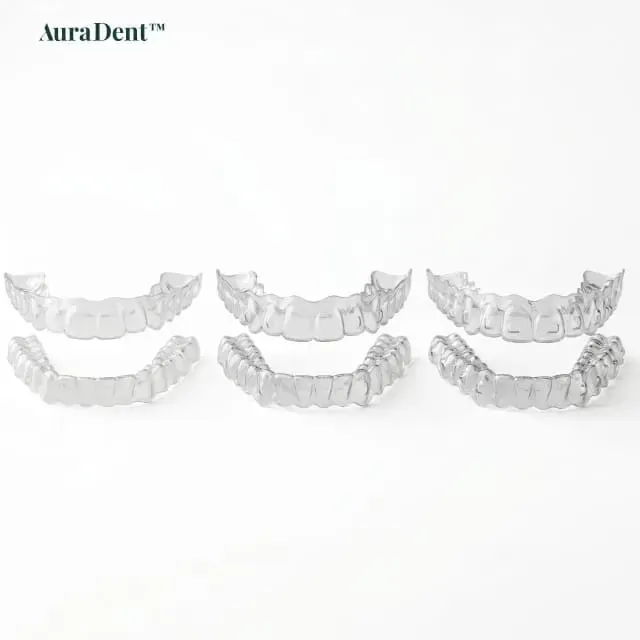
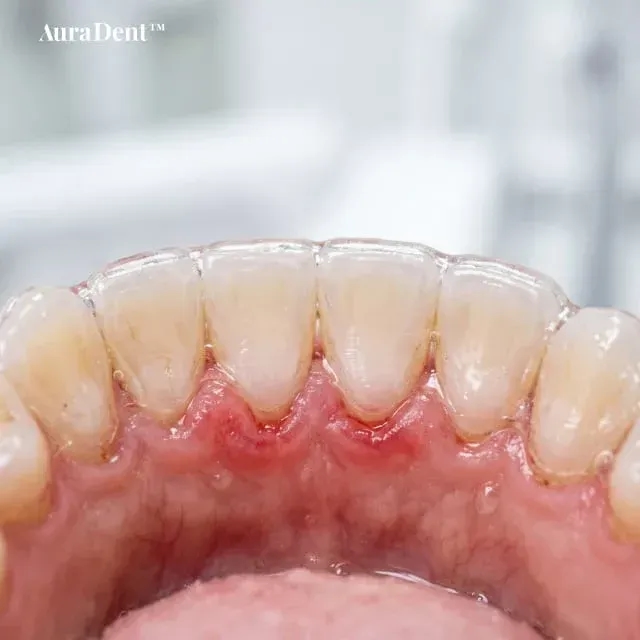
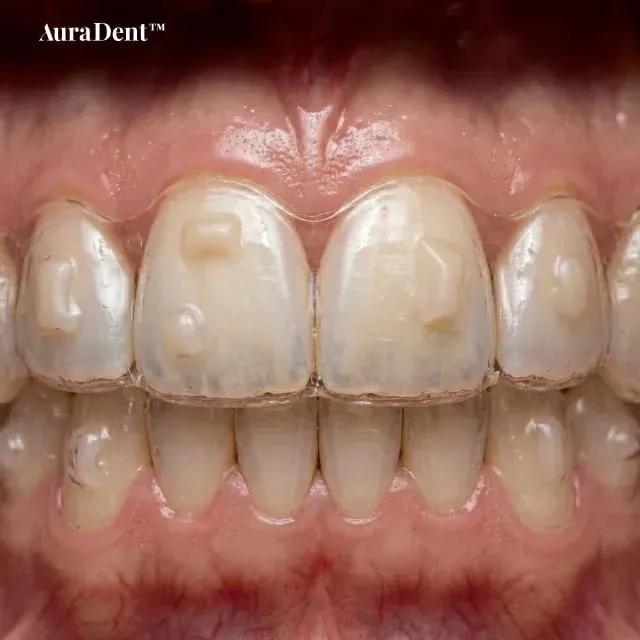
- General Dentistry
Invisalign for Complex Dental Problems: Results and Solutions
Key points at a glance
• Invisalign for complex dental issues can correct crowded teeth, large gaps, and malocclusions.
• Modern techniques such as elastics, attachments, and mini-implants enable advanced tooth movement.
• Treatment time is longer, but the results are often just as precise as with traditional braces.
• Success depends on the patient’s compliance and the dentist’s experience.
• At AuraDent™, we use 3D scanning and digital planning for maximum precision and comfort.
What counts as a complex case in orthodontics?
A complex case involves multiple tooth movements occurring simultaneously or requires significant adjustment of the bite. Invisalign can address these challenges through carefully planned steps and complementary techniques.
Severe crowding
When there isn’t enough space in the jaw, teeth can overlap. This increases the risk of difficulty cleaning them and gum problems. Invisalign can create space using a technique called interproximal reduction, in which a very small amount of enamel is removed to give the teeth room to move.
Large gaps between the teeth
If you have larger gaps, Invisalign can be combined with small temporary mini-implants that act as anchors to close the gaps. This method provides a high degree of control over tooth movement and leads to a smooth, natural-looking result.
Deep bite and open bite
These malocclusions are more challenging because they affect both function and aesthetics. Invisalign can correct mild to moderate cases, often using elastics to adjust the position of the upper and lower jaws. In more complex cases, a combination of treatments is required for the best results.
Teeth that require rotation
When teeth are severely rotated, aligners can be fitted with small attachments. These act as grip surfaces, making it possible to rotate the teeth more effectively and in a controlled manner.

Real Results: Before and After Invisalign
Modern digital treatment plans make it possible to see a 3D simulation of your future smile as early as the first consultation. At AuraDent™, many patients with complex initial conditions have achieved stable and aesthetically pleasing results. The difference is visible not only in the alignment of the teeth but also in the entire facial profile, where harmony is restored.
Want to see more examples? Visit our gallery of before and after photos to discover how advanced Invisalign treatment can transform both your smile and your self-confidence.
The secret to success: Combining rubber bands and attachments
In some cases, Invisalign requires support from other components to achieve optimal results.
- Interdental elastics: These small elastic bands are used to adjust the position of the jaw and improve bite function. They are discreet, easy to use, and an important part of many complex treatments.
- Attachments: Small, tooth-colored buttons are temporarily attached to certain teeth and serve as anchor points for the aligners. They help provide precise control over tooth movement without being visible.
Together, these additions allow Invisalign to be used for a much broader group of patients than before, including those who were previously only recommended traditional braces.
Want to know which type of Invisalign treatment is best for your specific case? Read our comparison of Invisalign Go, Go Plus, and Comprehensive to understand the differences in duration, scope, and results. It will help you choose the most effective path to your new smile.
Invisalign experiences: What do patients say?
Most patients describe the treatment as surprisingly simple and comfortable. The pressure felt during the first few days is often interpreted as a sign that the teeth are moving as planned. Many also say that the digital planning provides reassurance, since they can see what the final result will look like right from the start.
Patients with complex initial conditions particularly emphasize how much easier daily life becomes compared to metal braces. The ability to remove aligners during meals, socialize, and speak freely makes the treatment both discreet and practical.
Achieving a beautiful smile is not just about aesthetics but also about health. In our article on Invisalign and oral health, you’ll learn how the treatment affects your gums, oral hygiene, and existing oral health issues. It’s the perfect read for anyone who wants to understand the full picture before starting treatment.

Why Choose an Experienced Dentist for Complex Invisalign Cases
The more complex the case, the more important the dentist’s experience becomes. A knowledgeable practitioner can determine when complementary techniques such as IPR or mini-implants are needed, and how best to combine these with aligners to achieve a precise result. At AuraDent™, advanced 3D technology is used to plan every movement, ensuring high precision and stability throughout the treatment.
Attachments play a crucial role in the precision of your treatment. Learn more about how Invisalign attachments work and why they are important for achieving precise and long-lasting results. A short but important read for anyone who wants to understand the technology behind their new smile.
Conclusion
Invisalign for complex dental issues is now a realistic and effective solution thanks to modern technology and careful planning. By combining digital design, attachments, elastics, and personalized follow-up, even advanced bite issues can be treated with predictable results.
If you’ve been told your case is too complicated for Invisalign, book a free consultation at AuraDent™. Our team will digitally analyze your bite and show you exactly what your future smile could look like before treatment even begins.
FAQs
Dr. Panteha Bigdeli
Related Posts