
- General Dentistry
- Cosmetic Tips
Which type of braces is right for you? An explanation of the different types of braces
.webp&w=3840&q=100)
Why Orthodontics Is Necessary: More Than Just an Aesthetic Procedure
Crooked teeth can make cleaning more difficult, thereby increasing the risk of both cavities and gum disease. Malocclusions such as overbite, underbite, crossbite, or open bite can also affect chewing ability, speech, and sometimes even the function of the temporomandibular joint. For those wondering what to say to get braces, it’s good to know that the dentist bases their decision on a combination of medical and functional needs, not just aesthetic preferences.
Early diagnosis in children can guide tooth development in the right direction, but adults can also achieve good and stable results with properly planned treatment. For those wondering how braces work, the answer is that the principle is based on carefully controlled forces that gradually move the teeth, thereby improving both the function and appearance of the bite.
Different Types of Braces: An In-Depth Overview
Metal Braces with Front-Facing Brackets
Description:
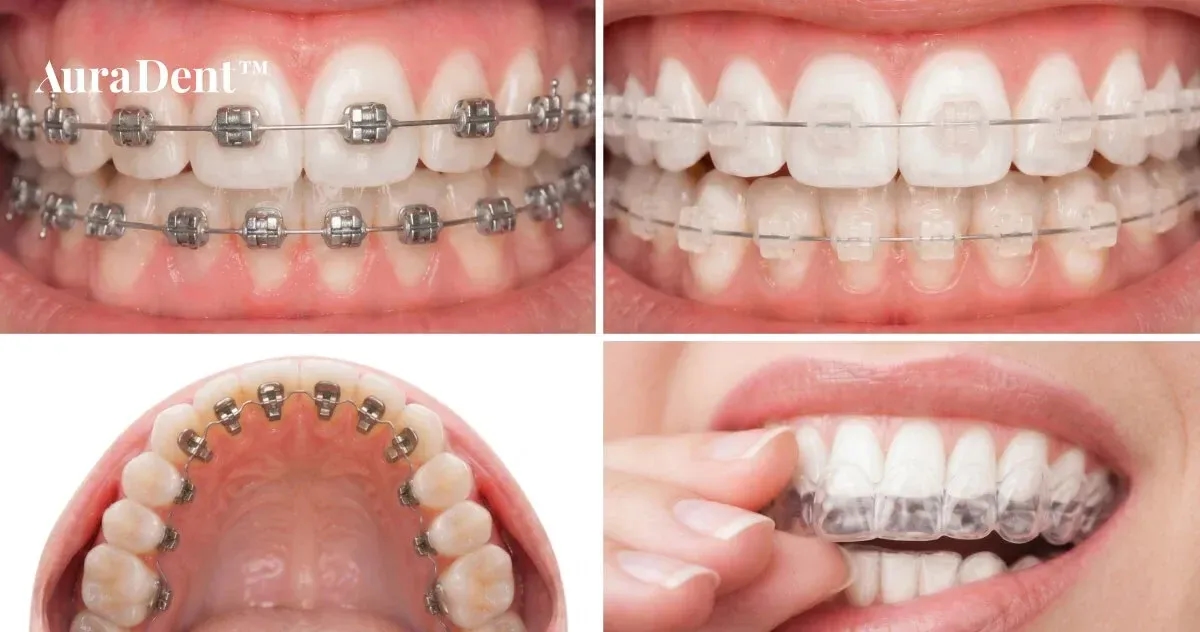
Metal braces, often called traditional braces, consist of small metal brackets attached to the front of the teeth and connected by a metal archwire. The archwire is adjusted regularly to gradually move the teeth in the desired direction. It is the most widely used and well-established method in orthodontics and works for both simple and more complex treatments.
Advantages:
- Provides very high precision in tooth movement.
- Can treat even complex cases, such as severe crowding or extensive malocclusions.
- Is often the most cost-effective option, making it accessible to many patients.
Disadvantages:
- Because they are visible, some patients find them aesthetically unappealing.
- Dietary restrictions are common because hard or chewy foods can damage the brackets.
- Requires excellent oral hygiene, as the brackets and archwire make cleaning more complicated and increase the risk of plaque buildup.
Suitability:
Metal braces are particularly recommended when treatment is more complex or when the highest possible control over tooth movement is needed. They are often used for children, adolescents, and adults.
Ceramic Brackets
Description:
Ceramic brackets function in the same way as metal brackets, but they are made of tooth-colored or transparent ceramic material. This makes the braces significantly more discreet than the metal version.
Advantages:
- Less visible than metal brackets, making them popular among adults who want a more aesthetically pleasing solution.
- Effective for the same types of treatments as metal brackets and can address everything from minor adjustments to more complex malocclusions.
Disadvantages:
- More expensive than metal brackets due to material costs and more advanced manufacturing.
- Elastic components and the brackets themselves can become discolored by pigmented beverages such as coffee and tea if oral hygiene is not carefully maintained.
- Ceramic is more brittle than metal and can therefore come loose or break more easily.
Suitability:
Ceramic brackets are often recommended for patients who prioritize an aesthetically discreet option but who also need the stability and effectiveness that fixed braces provide.
Lingual Braces
Description:
Lingual braces involve placing brackets and wires on the inner surface of the teeth, that is, against the tongue, making them completely invisible from the outside. The braces are custom-made for each patient using advanced technology.
Advantages:
- Complete aesthetics, as the braces are not visible at all when smiling or speaking.
- Offers high precision and can treat most types of malocclusions, including crowding and bite issues.
Disadvantages:
- Higher cost than other options due to more advanced manufacturing and longer treatment time in the chair.
- Speech may be affected initially, especially when pronouncing certain sounds, but this often improves after a short adjustment period.
- Cleaning is more challenging because the brackets are harder to reach.
Suitability:
Lingual braces are particularly suitable for adults with high aesthetic standards, such as those in professions where appearance plays a major role.
Invisalign (removable aligners)
Description:
Invisalign is a modern system that uses clear, removable plastic trays, known as aligners, to gradually move the teeth. Each aligner is custom-made for the patient’s teeth and is replaced every two to three weeks.
Advantages:
- The aligners are nearly invisible, making them attractive to patients who want to avoid visible brackets.
- They can be removed during meals and when brushing teeth, which simplifies oral hygiene and eliminates the dietary restrictions associated with fixed braces.
- Offers high comfort since aligners lack metal brackets that can irritate the mucous membranes.
Disadvantages:
- Requires very good compliance. Aligners must be worn at least 22 hours a day to achieve the desired results.
- Is not always the best choice for complex cases requiring more advanced movements.
- The cost is higher than for metal braces.
Suitability:
Invisalign is one of the most popular options among adults and teenagers with mild to moderate misalignments, especially among those who value aesthetics and flexibility in treatment.
Retainers and Other Devices
Description:
After treatment is complete, retainers are used to maintain the results. These can be fixed, such as a thin wire bonded to the inside of the tooth, or removable aligners worn at night. In some cases, other devices, such as elastics or growth-guiding appliances, may be part of the treatment.
Advantages:
- Stabilizes the results and reduces the risk of relapse.
- Can be customized to the patient’s needs, either as a fixed or removable option.
Disadvantages:
- Requires continued compliance and good oral hygiene.
- Removable retainers can be lost or damaged.
Suitability:
Retainers are an essential part of all treatments and are used to ensure long-term stable results.
How do you choose the right option?
The choice of orthodontic treatment depends on several factors. There is no one-size-fits-all answer; the decision is always made in consultation with your dentist. The most important considerations are:
- Severity of the condition: Complex cases often require fixed appliances to provide adequate control.
- Aesthetics: Adult patients often prioritize discreet options such as ceramic brackets or aligners.
- Cost: Prices vary between systems. Metal braces are usually the most cost-effective, while lingual braces and aligners can be more expensive.
- Lifestyle: Athletes or people who travel frequently may prefer aligners, as they can be removed during meals and exercise.
- Age: Treatment can be performed on both children and adults, but in children, growth can sometimes be utilized in the therapy.
- Cooperation: Aligners require a great deal of discipline, as they must be worn for at least 22 hours a day.
The Treatment Process at the Clinic
Orthodontic treatment often follows a clear pattern:
1. Consultation and Diagnosis
- Clinical examination of teeth and bite
- X-rays, photographs, and digital 3D scans
- Assessment of treatment needs and conditions
2. Treatment Plan
- A personalized plan with goals and estimated duration
- Discussion regarding treatment options and questions such as how long the braces will be worn
- Information about cost and practical aspects
3. Start of treatment
- Placement of brackets for fixed braces
- Dispensing of aligners with care instructions
- Advice on diet and cleaning
4. Follow-up
- Regular check-ups to ensure treatment is progressing as planned
- Adjustment of archwires for fixed appliances
- Verification that aligners are being used correctly
5. Retention phase
- Stabilization of results with a retainer
- May be fixed (thin wire on the inside) or removable (night guard)
Oral hygiene during treatment
- For fixed braces: use interdental brushes, fluoride supplements, and proper brushing technique
- For aligners: rinse and brush your teeth after every meal, and clean the aligners thoroughly
Conclusion
Today, orthodontic treatment offers several different options that can be tailored to the patient’s needs and preferences. Traditional metal braces provide reliable results, ceramic braces are more discreet, lingual braces are invisible from the outside, and Invisalign® offers flexibility and easy oral hygiene.
The crucial step is a professional assessment, which takes into account the diagnosis, lifestyle, and treatment goals. Through a carefully designed plan, the patient can achieve both functional improvements and an aesthetically sustainable result.
FAQs